There are over 100 tombs located within St. Peter's Basilica, many located in the
, beneath the Basilica. These include 91 popes, St.
. Exiled Catholic British royalty
. The most prominent woman entombed is
, who abdicated her throne in order to convert to Catholicism. The most recent interment was
. Beneath, near the
".
. Quarrying of stone for the Colosseum had, in turn, been paid for with treasure looted at the
in 70 AD.
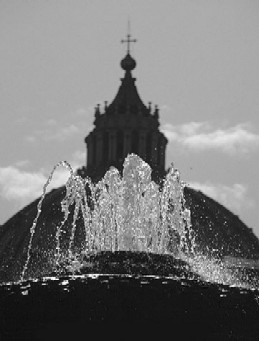
Main article: Saint Peter's Square St Peter's Square There is a widespread assumption that the dome, or
cupola, as it presently stands, was designed by
Michelangelo, who became chief architect in 1546. In fact, Michelangelo's design called for a spherical dome. At the time of his death (1564), only the drum set, the base on which a dome rests, had been completed. The dome proper was redesigned and vaulted by the architect
Giacomo della Porta, with the assistance of
Domenico Fontana, who was probably the best engineer of the day. Fontana built the lantern the following year, and the finial was placed in 1593. Many are fascinated by the ability of the artist of who created it.
As built, the double dome is brick, 42.3 meters (138.8
ft) in interior diameter (almost as large as the
Pantheon), rising to 120 meters (394 ft) above the floor. In the mid-18th century, cracks appeared in the dome, so four iron chains were installed between the two shells to bind it, like the rings that keep a barrel from bursting. (Visitors who climb the spiral stairs between the dome shells can glimpse them.) The four piers of the
crossing that support it are each 18 metres (59 ft) across. It is not simply its vast scale (136.57 m or 448.06 ft from the floor of the church to the top of the added cross) that makes it extraordinary. Della Porta's dome is not a
hemisphere, but a
paraboloid: it has a vertical thrust, which is made more emphatic by the bold ribbing that springs from the paired
Corinthian columns, which appear to be part of the drum, but which stand away from it like buttresses, to absorb the outward thrust of the dome's weight. The grand arched openings just visible in the illustration but normally invisible to viewers below, enable access (but not to the public) all around the base of the drum; they are dwarfed by the monumental scale of their surroundings. Above, the vaulted dome rises to Fontana's two-stage lantern, capped with a spire.
The egg-shaped dome exerts less outward thrust than a lower hemispheric one (such as
Mansart's at
Les Invalides) would have done. The dome conceived by
Donato Bramante at the outset in 1503 was planned to be carried out with a single masonry shell, a plan discovered to be infeasible.
Antonio da Sangallo the Younger came up with the double shell, and Michelangelo improved upon it. The piers at the crossing, which were the first masonry to be laid, and which were intended to support the original dome, were a constant concern, too slender in Bramante's plan, they were redesigned several times as the dome plans evolved.
Other domes around the world, built since, are generally compared to this one or contrasted with it.
Dome Above the main entrance is the inscription,
The façade is 114.69 metres (376.28 ft) wide and 45.55 metres (149.44 ft) high. On top are statues of Christ,
John the Baptist, and eleven of the apostles; The statues of St Peter and St Paul are in front of the parish. Two clocks are on either side of the top, the one on the left has been operated electrically since 1931, its oldest bell dating to 1288.
Between the façade and the interior is the
portico. Mainly designed by Maderno, it contains an 18th century statue of
Charlemagne by
Cornacchini to the south, and an
equestrian sculpture of
Emperor Constantine by Bernini (1670) to the north. The southernmost door, designed by
Giacomo Manzù, is called the "Door of the Dead". The door in the center is by
Antonio Averulino (1455), and preserved from the previous basilica.
The northernmost door is the "Holy Door" in bronze by
Vico Consorti (1950), which is by tradition, only opened for great celebrations such as
Jubilee years. Above it are inscriptions, the top reading
PAVLVS V PONT MAX ANNO XIII, and the one just above the door reading
GREGORIVS XIII PONT MAX. In between are white slabs commemorating the most recent openings.
IOANNES PAVLVS II P.M. PORTAM SANCTAM ANNO IVBILAEI MCMLXXVI A PAVLO PP VI RESERVATAM ET CLAVSAM APERVIT ET CLAVSIT ANNO IVB HVMANE REDEMP MCMLXXXIII – MCMLXXXIV
IOANNES PAVLVS II P.M. ITERVM PORTAM SANCTAM APERVIT ET CLAVSIT ANNO MAGNI IVBILAEI AB INCARNATIONE DOMINI MM-MMI
PAVLVS VI PONT MAX HVIVS PATRIARCALIS
 VATICANAE BASILICAE PORTAM SANCTAM APERVIT ET CLAVSIT ANNO IVBILAEI MCMLXXV
Interior Façade
St. Peters, seen from above
High altar
Dome 1
Dome 2
Dome 3
View of the Dome from the Drum
High altar
Bernini's "Cathedra Petri" and "Gloria"
The Basilica of Saint Peter viewed from the Ponte Sant'Angelo
The facade of Saint Peter's Basilica at dusk
..and at dawn
The narthex or entrance hall has three doors
View from the first step beyond the entrance hall
Giovanni Paolo Pannini's painting of the nave of the Basilica of Saint Peter
Bernini's canopy
The confessio.
The tomb of Pope Alexander VII, by Gianlorenzo Bernini
La
Pietà sculpted by Michelangelo Buonarroti
Interior view of the sanctuary looking from the dome towards the apse
The view from the top of the dome
Saint Peter's Basilica
Statue of Saint Peter
The interior
Archpriests of Saint Peter's Basilica since 1820
No comments:
Post a Comment